Use An Editing Service?
Your publication manuscript is finished, and you have carefully followed the author guidelines of the target journal. The manuscript tells how your “good idea” became a hypothesis, why you did what you did to test it, how you did it, what you found, and why it’s important. It is easy to talk about your findings, but If your first language is not English it may not be as easy to write about it. You want your research to be reviewed on its scientific merit, not on its use of language. Would editing by a native English speaker increase your chance of acceptance with only minor revisions? Most likely it would, because reading and speaking English are easier than writing it. Your study may be “a good job well done that adds to what is already known,” but if it does not deliver its message clearly, it will not get the attention it deserves.
If you haven’t done it already, discuss with your co-authors how the information in your manuscript flows step-by-step from the introduction through the methods, results, discussion, and conclusion. Use the diagram on the home page of the Website as a reference. After all, “a picture can be worth 1000 words,” Visualize your message as paragraphs lined up like a circle of dominoes. If you tip the first one over, it starts a wave that ends when the last one falls over. After you are sure that your manuscript says what you mean in the best English you can write, ask your AI assistant to find and fix mistakes and correct them. It can check grammar, spelling, punctuation, and consistency. It can standardize tense (past and present) and voice (active and passive), and tighten sentence structure. It can improve clarity and readability by reducing wordiness and repetition. The result is a manuscript that reads like one written by a native English speaker. You will get the best results by asking for an "academic" style and settings that “reduce wordiness” or “word count," “make concise,” and “improve flow or fluency." Then do a final round of “language polishing” and proofreading. Try various apps until you find one that you like.
But you are not done. Check carefully to ensure that the edits did not change the way you want to describe your study, especially your methods and results. An AI editor improves your writing, but it is not a scientist. Did it change any numbers or units? Double-check the data in the tables, figures, and text. For example, did it change “µg/ml” to “mg/ml” because it thought “µg” was a typo? Even the MS Word spell check does that. Did it replace technical terms with words that are not in the scientific vocabulary? For example, “heart attack” instead of “myocardial infarction.” Did it alter the logic? Check carefully to be sure your manuscript still passes the “domino test.” Have your computer read your manuscript aloud. Sometimes, you will hear things that you want to change. Now, do a final QA check to ensure that the manuscript follows the author instructions of the target journal.
You and your co-authors have full ownership of the manuscript. Let your experience in publishing previous articles guide you when asking for editing assistance. If you want a “second opinion,”, ask for our “How Does it Look” service. Ask for “Gist it” to have a suggested revisions of the title and abstract to increase the chances of attracting editors, reviewers, and journal readers. You can use “Gist it“ to request a draft submission cover letter. After all, it’s intended to as pique the interest of the editor get him to accept the article for peer review.
Good luck with your submission.
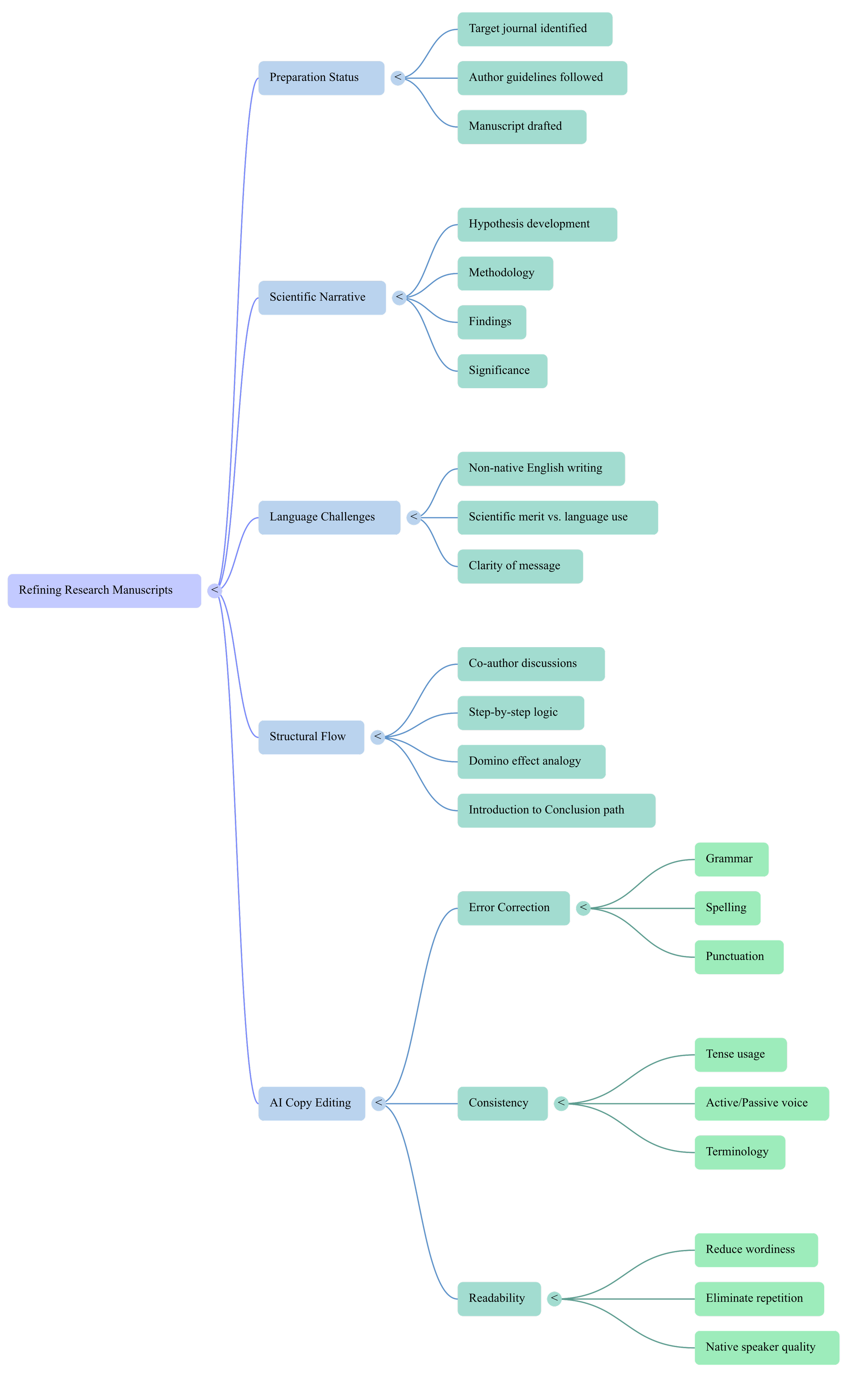
Mind map summary of what you can do to help decide whether to use a human medical editing service